The Resemblance Between Dieter Rams’s Designs and Apple Products
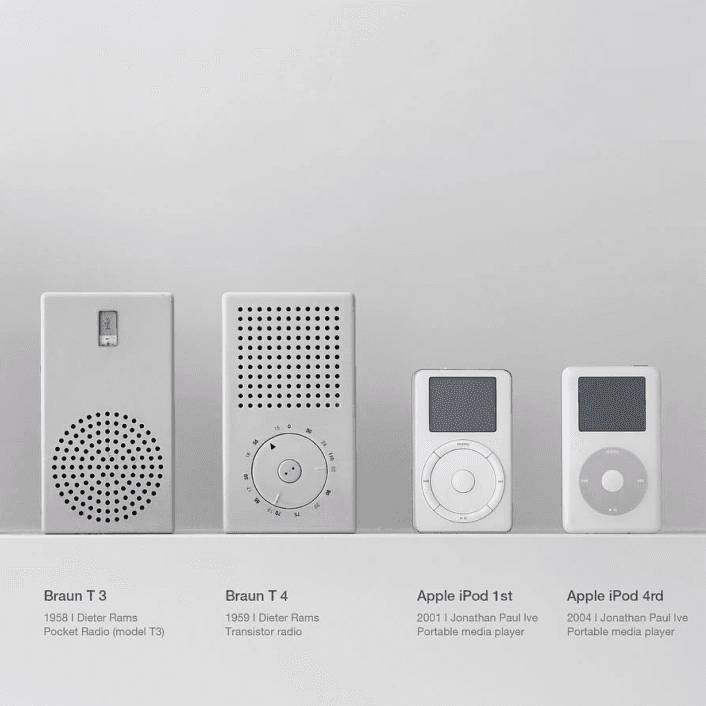
The resemblance between Dieter Rams and Apple is more than a question of formal borrowing. What truly matters is the design culture Rams developed at Braun — clarity, hierarchy, restraint, legibility and a calm user-centred aesthetic — and the way it found a contemporary reinterpretation at Apple, particularly during the Jony Ive era. The kinship between the Braun ET66 and Apple’s calculator interface, or between Rams’s radios and audio devices and products such as the iPod and iPhone, is too strong to dismiss as coincidence. The connection is less about copying forms one by one than about proportion, surface logic, interface thinking, colour economy and the relationship established with the user. What makes the comparison valuable is that it shows good design as a set of principles rather than a surface style. Rams’s “less, but better” becomes product clarity at Apple: an object should communicate its use, reduce cognitive noise and avoid allowing form to overpower function. Yet an important difference remains. Rams’s design ethic is more explicitly tied to durability, longevity and a critique of consumption, while Apple does not always meet the same ethical standard. The relationship is therefore not only one of resemblance, but also of tension — and that tension makes the comparison more revealing.
View source ↗Back to references